The delivery problem
How does a copper peptide get through skin?
A promising culture result still has a physical journey to make. The apparatus brings that journey into focus for me.
An experiment with skin layers
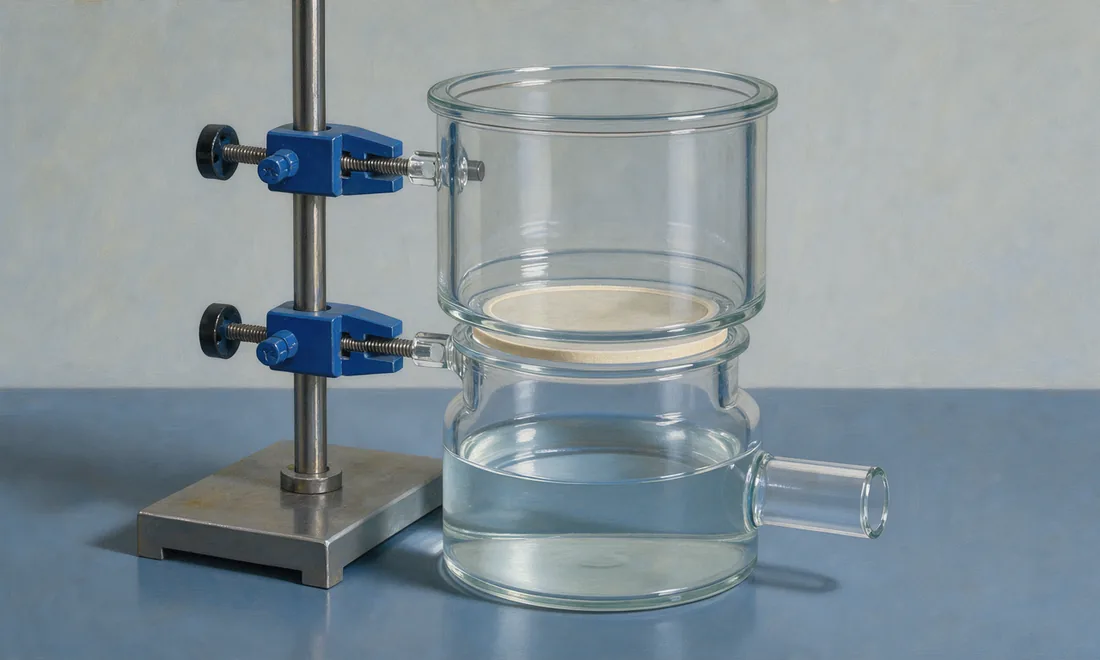
The human skin-penetration study examined copper applied as the GHK-Cu tripeptide, with penetration assessed by skin layer. This was work on human skin outside the body. Dermatomed skin, cut to a controlled thickness, was part of the experiment. Those details give the work a physical setting that the phrase topical peptide tends to leave out.
The researchers measured copper permeating through skin and copper retained as a dermal depot, meaning a retained store within the skin. Movement through the sample and retention within it are separate observations. Those separate destinations are the attraction: where did the measured material go, and how much remained?
The measured material also deserves attention: the study reports copper delivery and retention after application of the tripeptide complex. I would not silently rename those measurements as an amount of intact peptide reaching every intended target. Staying with copper preserves what is interesting about the experiment without asking it to identify more than the reported outcome.
Copper measured over 48 hours
Over 48 hours in the skin-layer experiment, 136.2 +/- 17.5 ug/cm^2 of copper permeated through dermatomed human skin, while 97 +/- 6.6 ug/cm^2 was retained as a dermal depot. Here ug/cm^2 means micrograms per square centimetre. The reported quantities concern copper under those experimental conditions.
The retained material deserves as close a look as the copper that crossed. It gives the skin a role beyond a barrier that material either crosses or fails to cross: retention within the sample was also measured. The paper makes room for both destinations. That is the reason for lingering over this experiment before returning to the face.
Why formulation takes centre stage
The 2025 topical GHK review describes poor stratum-corneum permeability as the central delivery challenge. Here the outer barrier of skin is a practical obstacle in the research story. An active response in a culture dish and a useful topical formulation involve different experimental work.
At first I focused on the destination: the molecule's activity once it reached cells. The delivery literature shifted my emphasis. Before a topical claim can borrow the excitement of a cell result, the formulation has to make sense on skin. That sounds ordinary, yet it diminishes the appeal of an ingredient name detached from its formulation.
The review considers palmitoylation, a chemical modification of GHK, and microneedle pretreatment among strategies for improving delivery. These are descriptions of research approaches. They bring altered chemistry or altered experimental conditions into the account, each of which deserves its own evaluation. The review is useful precisely because it treats delivery as an experimental problem in its own right.
Retention and facial outcomes
Evidence of a retained copper depot in excised human skin is a delivery observation. Evidence of a change in wrinkle depth or skin laxity, as discussed in the skin-regeneration review, answers an appearance question. Both questions deserve room because each supplies something the other leaves unresolved.
The depot result gives local availability a concrete foothold in the discussion. It does not specify how much visible improvement a face will show, how long any improvement will last, or which formulation will reproduce it. Those questions need observations of their own. Likewise, a favorable facial finding becomes easier to interpret when the formulation and delivery conditions are described well enough to connect it to the underlying work.
I favor an account in which a difficult physical link gets as much attention as an attractive outcome. The skin barrier is one of those links. The facial-studies piece picks up the reported appearance outcomes and a percentage that is easy to remember more generously than its meaning allows. The collagen essay returns to what happens when the compound is supplied directly to cultured cells.